Ambulance Orientation
A digital learning experience designed for students in paramedicine.
About the project
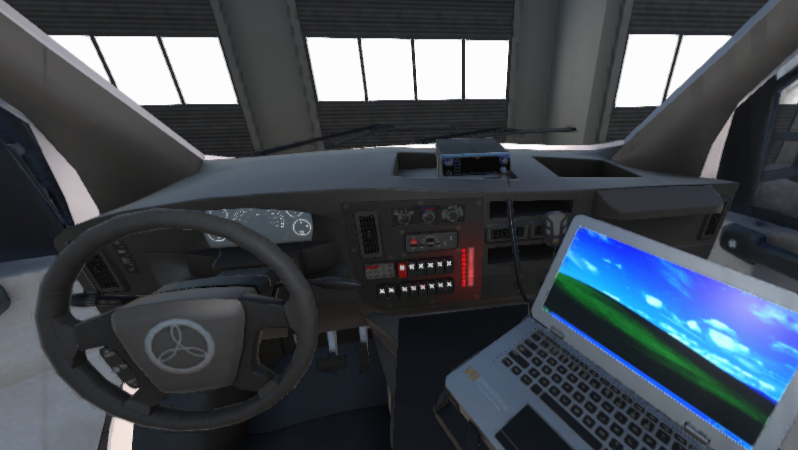
Ambulance Orientation was developed for Conestoga College’s paramedicine program. It recreates an in-service ambulance from the Waterloo Region, giving first-year students a chance to become familiar with the vehicle before beginning ride-alongs in their second year.
The experience was built in Unity and delivered through Brightspace as a SCORM package. I worked on the project for its full development lifecycle as part of a team of roughly six people. As the team changed over time, I also helped onboard new developers and get them familiar with the project.
Objective tracking
My main area of ownership was the objective tracking system. Starting from a wireframe provided by our UI/UX designer, I built the interface along with the managers responsible for tracking and updating objectives as learners progressed through a scenario.
The system needed to respond to what the learner was doing while keeping their current objectives easy to reference. I also developed other parts of the interface, including scenario selection, information pop-ups, and conversational dialogue.
Building the interface
The UI was built with Unity UI Toolkit. I used USS themes and reusable elements so that screens could share styling and components rather than maintaining each interface separately.
Because the project was delivered through an LMS, the Unity application also had to work within the constraints of a browser-based learning experience. The finished build was packaged using SCORM and embedded into Brightspace alongside the rest of the paramedicine curriculum.
Testing with students
Before release, we ran focus groups and user acceptance testing with students. This gave us a chance to see how the intended users navigated the ambulance and interacted with the systems we had built.
Some behaviours that made sense during development were less obvious to someone seeing the experience for the first time. Feedback from these sessions informed changes to the interface and how information was presented during scenarios.
I also wrote unit tests for the systems I worked on and continued fixing issues as the project moved through testing and into production.
Exploring VR
Alongside the main project, we conducted a research project to investigate what would be involved in converting Ambulance Orientation into a VR experience. The goal was not to replace the existing SCORM module, but to estimate the development effort required for a conversion.
For this work, we used OpenXR and FlexXR, which allowed the existing UI Toolkit interfaces to be brought into world space. This gave us a practical way to evaluate how much of the existing application could carry over and which systems would need to be adapted specifically for VR.
Performance became more important in the headset version as well. I implemented occlusion culling to reduce unnecessary rendering within the ambulance and improve frame rate while evaluating the application on VR hardware.
Deployment
The main Ambulance Orientation experience was deployed through Brightspace for first-year paramedicine students at Conestoga College. Students can explore the ambulance and become familiar with its layout before encountering the environment during later practical training.
My work spanned the full development lifecycle, including system ownership, UI development, testing with students, UAT, maintenance, deployment, and the subsequent research into adapting the experience for VR.