Pallet Builder
An interactive training experience for learning safe and accurate pallet-building practices.
About the project
Pallet Builder is an interactive training module developed for Conestoga Meats to introduce employees to proper pallet-building practices before they move on to more advanced training.
Built in Unity and deployed as a WebGL application through the company's learning management system, the module gives learners an opportunity to apply what they have learned through hands-on exercises rather than relying solely on traditional course material.
I developed the project end-to-end, except for its 3D assets. My work included application architecture, interaction systems, UI/UX, learning content delivery, and SCORM integration to communicate learner data to the LMS.
Learning Through Interaction
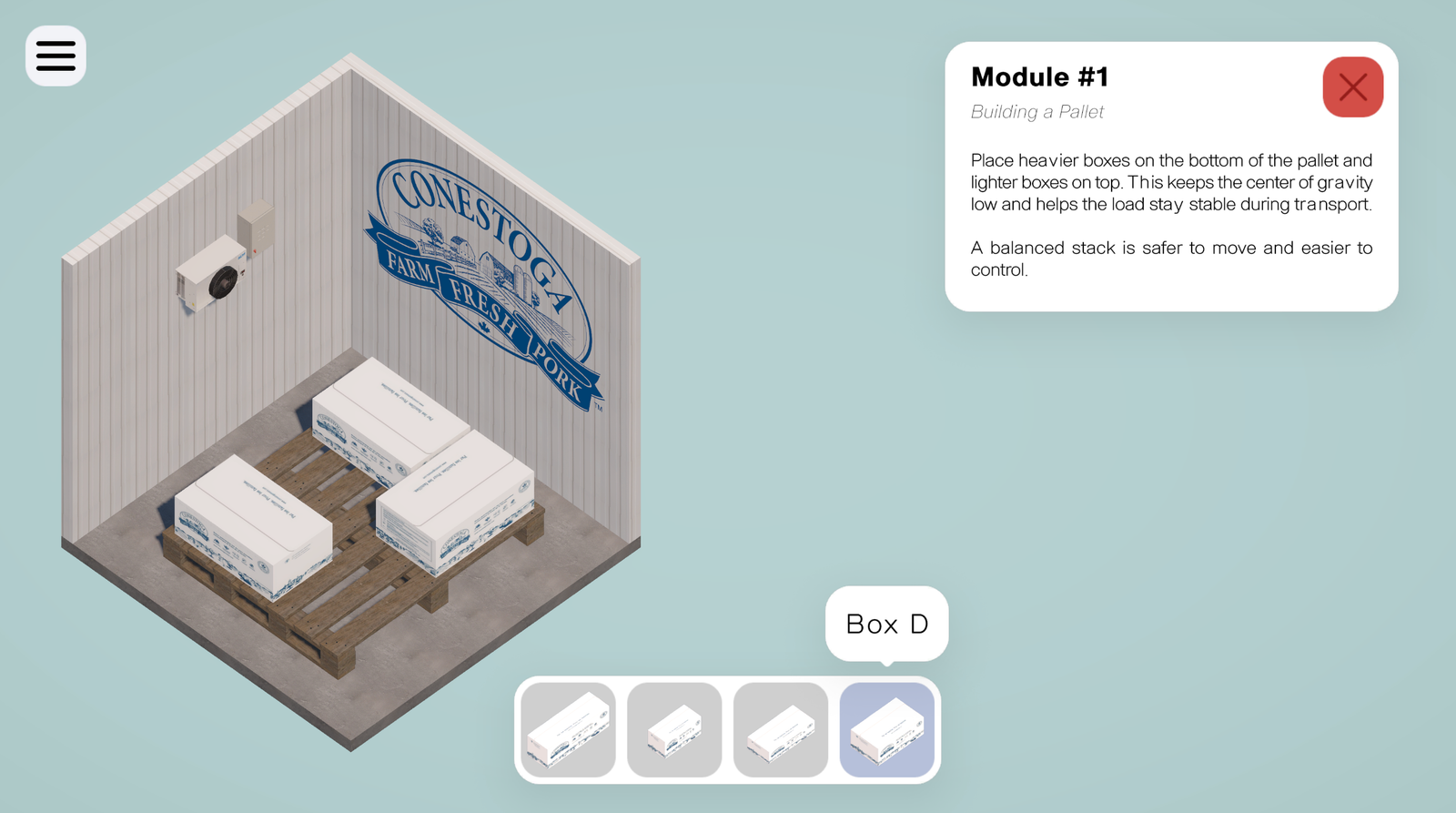
The central activity has learners build pallets using four different box types. Boxes can be selected from an on-screen inventory and placed directly onto the pallet, allowing learners to practice concepts such as weight distribution, stability, and order accuracy.
The placement system validates each action as the learner builds. Invalid placements are prevented, providing immediate feedback while allowing the learner to correct their approach and continue the exercise.
Later scenarios build on these fundamentals by asking learners to construct pallets according to mock invoices, combining the physical stacking rules with order-fulfillment requirements.
More Than a Simulation
Pallet Builder was designed as a complete learning module rather than a standalone simulation. Alongside the interactive pallet-building exercises, it supports instructional text, video content, information panels, and multiple-choice knowledge checks.
These components are integrated into a single progression system, allowing the experience to flow through instruction, assessment, and practical application without requiring the learner to leave the module.
LMS Integration
The application is packaged as a SCORM course and delivered through Conestoga Meats' existing LMS. This allows the Unity WebGL experience to participate in the same learning workflow as more conventional online training material.
Learner state is persisted through SCORM, allowing progress within the application to be saved and restored between sessions. This required designing the module around the constraints of an LMS-hosted WebGL application while maintaining a cohesive experience for the learner.
Preparing Learners for VR
Pallet Builder serves as an introductory step before a separate VR pallet-stacking simulation. Rather than introducing the rules of pallet building for the first time in VR, the module provides learners with a lower-friction environment to understand the underlying concepts and practice them first.
This progression lets the VR experience focus more heavily on applying those skills in an immersive environment, while Pallet Builder establishes the knowledge and decision-making required beforehand.
My Role
I was responsible for the project from initial implementation through its learning and interaction systems, owning the application code, UI/UX, content flow, and learner persistence. The 3D models were the primary project assets produced outside of my work.
The project brought together several areas of my development experience: Unity application development, interactive learning design, SCORM integration, UI/UX, and the design of systems that translate training requirements into something learners can actively practice.